An accessible adaptation can open the way into a story. Literary understanding develops through further engagement with the work: students examine motives, discover contradictions and recognise how the way a story is told influences their view of a character.
“Literatur, die ankommt” therefore combines text adaptation with focused textual analysis and classroom discussion.
Looking more closely
Selected key passages draw attention to significant moments. A character claims one thing but acts differently. A conversation changes a relationship. A narrator’s comment presents a scene in a new light.
In the fence scene from Tom Sawyer, for example, students can examine how Tom changes Ben’s view of the work. Observing Tom’s words and Ben’s reactions leads to an explanation of Tom’s approach supported by textual evidence.
Testing interpretations against the text
Students develop their own ideas, find relevant passages and explain their significance. Through discussion, they encounter other readings and reconsider their initial impressions. Different interpretations have a place when they are supported by clear and convincing reasoning.
Working with Language and Historical Distance
The English edition uses contemporary English. Language adaptation can, however, alter nuances and therefore requires careful choices. The source texts and the approach to adaptation are explained in the editions.
Historical living conditions and problematic beliefs are also part of studying these works. Explanatory notes and teaching prompts help students place them in context and examine them critically.
One Scene, Two Ways of Telling It
How do choices of language shape a literary text? A short extract from the storm scene places two versions side by side: Mark Twain’s English original of 1876 and the English reading edition 1.3 of «Literatur, die ankommt». The comparison draws attention to word choice, sentence structure and imagery. Our English edition is a translation of the project’s German adaptation.
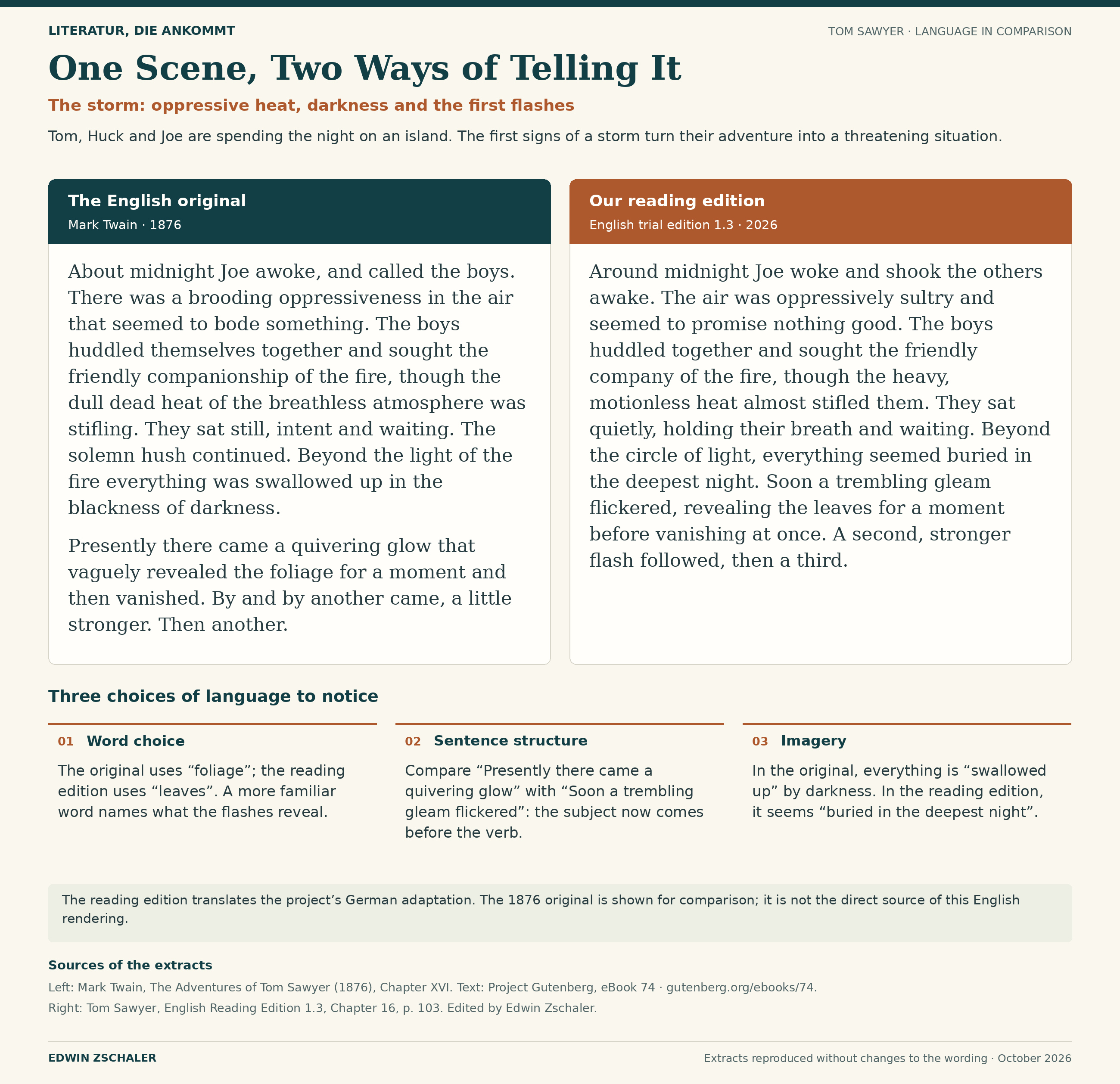
The comparison shows where word choice and sentence structure have been changed, and which images and narrative contrasts have been preserved. The years refer to the respective editions; a more recent publication does not automatically mean a new translation.